
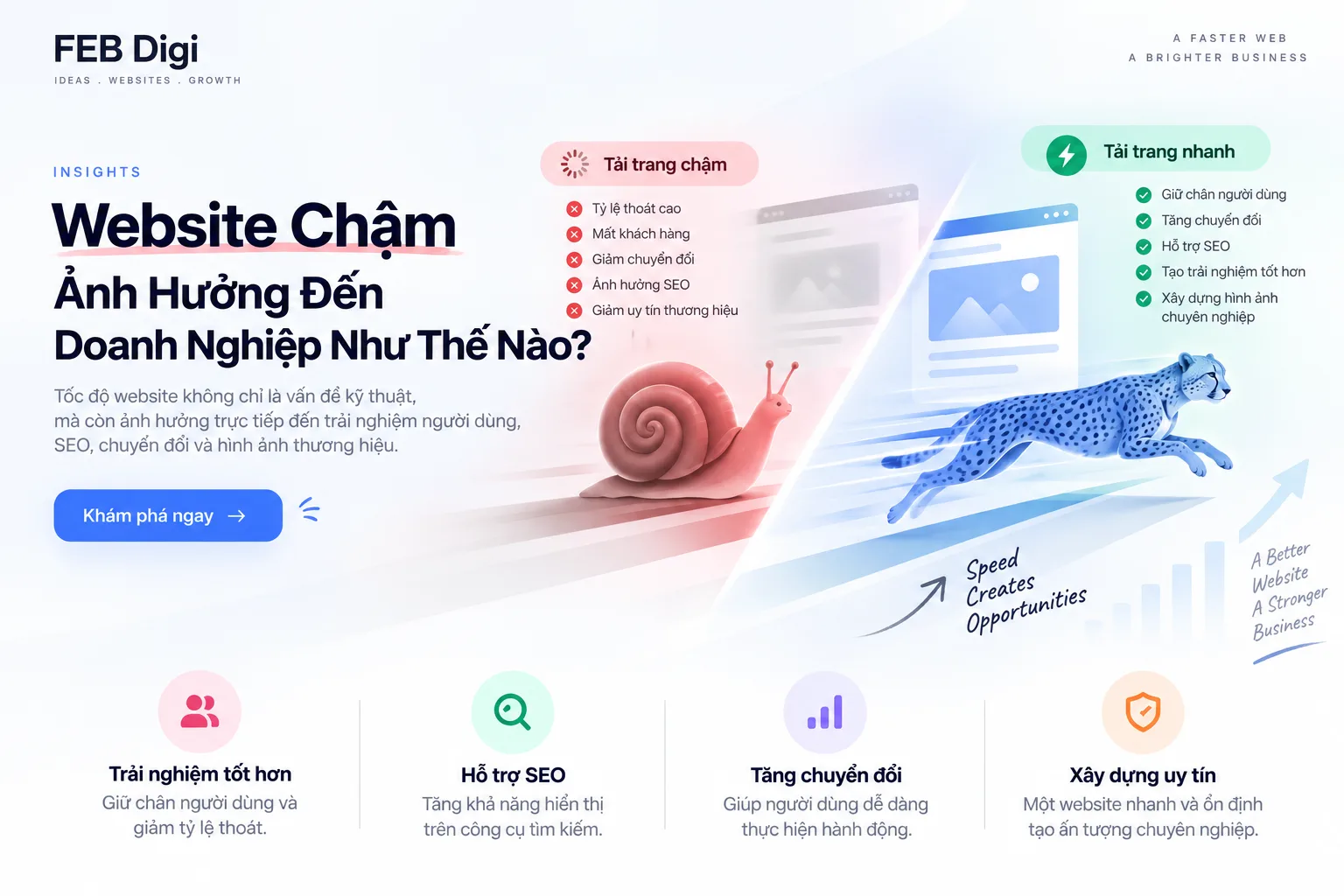
How Does a Slow Website Affect Your Business?
A Slow Website Is More Than a Technical Problem
A website can look great, but if visitors have to wait too long for it to load, they may leave before discovering what the business has to offer.
At FEB Digi, we see website performance as part of the overall user experience — not simply a technical score.
Speed Affects User Experience
Visitors usually arrive with a goal: exploring a service, viewing a product, finding information, or contacting the business.
Slow images, delayed interactions, and unstable layouts create friction, particularly on mobile devices. A fast and responsive website makes it easier for visitors to navigate content and complete important actions.
Does Website Speed Affect SEO?
Yes, but speed alone does not determine search rankings.
Google considers many signals when evaluating websites. Page experience and Core Web Vitals can help measure aspects such as loading performance, responsiveness, and visual stability.
Content quality, relevance, website structure, and links remain important, but strong technical performance creates a better foundation for both users and search engines.
Why Do Websites Become Slow?
Common causes include:
- Large, unoptimized images
- Excessive JavaScript or CSS
- Slow server responses
- Unoptimized databases or APIs
- Poor caching configuration
- Too many third-party scripts
Improving performance therefore often requires looking at the website as a complete system rather than applying a single optimization.
A Good Website Needs More Than Good Design
At FEB Digi, performance, responsive design, usability, and scalability are considered important parts of the development process.
The goal is not simply to achieve a perfect performance score. It is to build a website that feels fast, stable, and effortless to use.
Is your website running slower than it should? FEB Digi can help evaluate your current website and identify opportunities to improve its performance and user experience.