
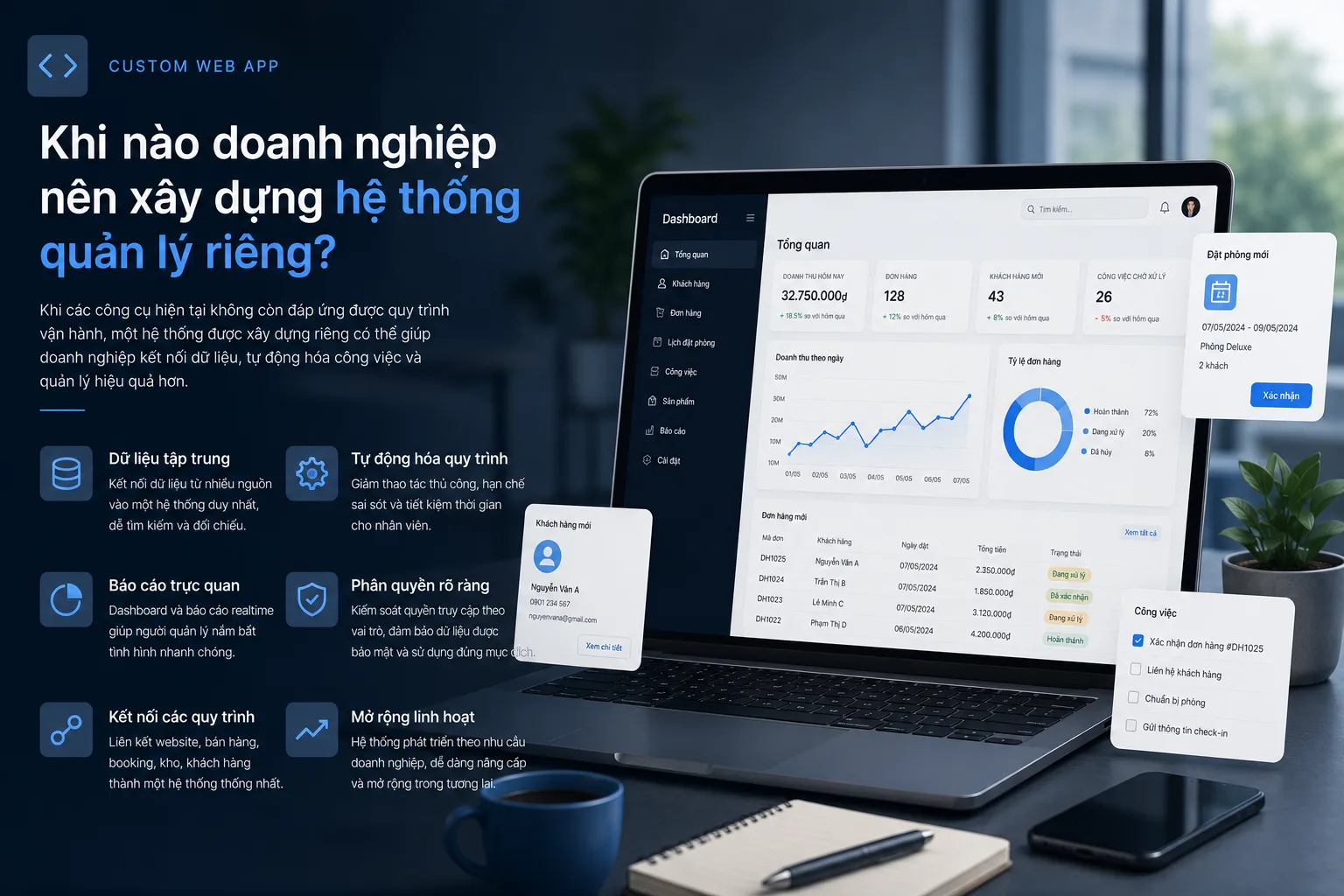
When Should a Business Build a Custom Management System?
As the number of customers, employees, and processes increases, outdated methods can create new problems.
Common problems include fragmented information, duplicate data, and lengthy report preparation times. In particular, managers will struggle to gather and analyze all the issues.
This is often when a company begins to consider a customized management system designed based on its actual operational processes.
1. Business data is spread across too many places
One department uses Excel. Another works in Google Sheets. Orders arrive through the website and social channels, while reports are maintained somewhere else.
As information becomes fragmented, finding and comparing data becomes increasingly difficult.
A custom management system can bring important business information into one platform.
Instead of switching between multiple files and tools, employees can access the information they need from one place.
2. Employees spend too much time on repetitive tasks
Another common sign is entering the same information multiple times.
A simple customer enquiry might require an employee to:
Receive information → update a spreadsheet → create an order → notify another department → update the status → prepare a report.
Every manual step requires time and introduces another opportunity for error.
A custom system can connect these activities into a single workflow and automate parts of the process.
3. Existing software does not match the workflow
Not every business needs custom software.
Off-the-shelf solutions are often excellent when a company's processes follow common workflows.
Problems begin when employees constantly have to change the way they work simply to accommodate the software.
Every business may handle quotations, orders, approvals, tasks, or customer relationships differently.
In these situations, a Custom Web App can be designed around the existing workflow instead of forcing the organization to redesign its operations around the software.
4. Management lacks a clear view of operations
With manually managed data, even simple questions can take time to answer:
How many orders came in today?
How many tasks are still pending?
What is this month's revenue?
Which customers are waiting for a response?
If answering these questions requires employees to combine multiple spreadsheets, management cannot react as quickly as it should.
Dashboards and reports can transform operational data into information that is easier to understand and monitor.
5. The business needs better access control
As a team grows, not every employee should have access to every piece of information.
Sales teams may need customer and order information.
Accounting may need payment data.
Managers may need performance reports.
Business owners may require access to everything.
A custom system can provide roles and permissions for different users, creating clearer responsibilities and better control over business data.
6. Different business processes need to work together
A website, booking system, sales process, customer database, and internal management tools do not have to operate independently.
For example, an enquiry submitted through the website could automatically create a new customer in the CRM.
A new reservation could immediately appear on an employee dashboard.
A completed order could automatically update a revenue report.
Connecting these workflows can significantly reduce repetitive administrative work.
Does every business need custom software?
No.
If the business is operating effectively with its existing tools, building a new system may not provide enough value.
A Custom Web App becomes worth considering when the cost of manual operations begins to exceed the benefits of continuing with existing tools.
That cost might appear as wasted employee time, data errors, difficult processes, or missed business opportunities.
Technology should adapt to the business
The purpose of custom software is not to pack as many features as possible into a system.
It should begin with simpler questions:
What does the business do every day?
Which activities consume the most time?
Which information needs to be managed more effectively?
Which processes could be automated?
From there, the system can be developed gradually around real business requirements.
A good Custom Web App should not force a business to adapt to technology.
Technology should adapt to the way the business actually works.
Khi doanh nghiệp còn nhỏ, việc quản lý khách hàng bằng Excel, nhận đơn hàng qua tin nhắn hay theo dõi công việc bằng nhiều công cụ khác nhau vẫn có thể hoạt động tốt.
Nhưng khi số lượng khách hàng, nhân viên và quy trình ngày càng tăng, những phương pháp này có thể bắt đầu tạo ra nhiều vấn đề.
Thông tin nằm ở nhiều nơi. Nhân viên phải nhập dữ liệu lặp lại. Báo cáo mất thời gian tổng hợp. Người quản lý khó theo dõi toàn bộ hoạt động của doanh nghiệp.
Đây thường là thời điểm doanh nghiệp bắt đầu cân nhắc một hệ thống quản lý được xây dựng riêng theo quy trình vận hành thực tế.
1. Dữ liệu đang nằm ở quá nhiều nơi
Một bộ phận sử dụng Excel. Một bộ phận lưu thông tin trên Google Sheets. Đơn hàng đến từ website, Facebook hoặc Zalo. Báo cáo lại được tổng hợp bằng một file khác.
Khi dữ liệu bị phân tán, việc tìm kiếm và đối chiếu thông tin trở nên khó khăn hơn.
Một hệ thống quản lý riêng có thể tập trung những dữ liệu quan trọng vào cùng một nền tảng.
Thay vì phải mở nhiều file và nhiều công cụ khác nhau, nhân viên có thể truy cập thông tin cần thiết tại một nơi.
2. Nhân viên phải thực hiện quá nhiều thao tác thủ công
Một dấu hiệu khác là cùng một thông tin phải được nhập lại nhiều lần.
Ví dụ, khi có khách hàng mới, nhân viên có thể phải:
Nhận thông tin → nhập vào Excel → tạo đơn hàng → thông báo cho bộ phận khác → cập nhật trạng thái → tổng hợp báo cáo.
Mỗi bước thủ công đều cần thời gian và có khả năng xảy ra sai sót.
Một hệ thống phù hợp có thể kết nối các bước này thành một quy trình thống nhất và tự động xử lý một phần công việc.
3. Phần mềm có sẵn không phù hợp với quy trình thực tế
Không phải doanh nghiệp nào cũng cần phần mềm riêng.
Các phần mềm có sẵn thường là lựa chọn rất tốt khi quy trình của doanh nghiệp tương đối phổ biến.
Vấn đề xuất hiện khi doanh nghiệp phải liên tục thay đổi cách làm việc chỉ để phù hợp với phần mềm.
Mỗi doanh nghiệp có thể có cách báo giá, xử lý đơn hàng, phân công công việc, duyệt yêu cầu hoặc chăm sóc khách hàng khác nhau.
Trong trường hợp đó, một Custom Web App có thể được thiết kế dựa trên quy trình hiện tại thay vì buộc doanh nghiệp thay đổi toàn bộ cách vận hành.
4. Người quản lý khó biết doanh nghiệp đang hoạt động như thế nào
Khi dữ liệu được quản lý thủ công, một câu hỏi đơn giản đôi khi cũng cần rất nhiều thời gian để trả lời:
Hôm nay có bao nhiêu đơn hàng?
Bao nhiêu công việc chưa hoàn thành?
Doanh thu tháng này như thế nào?
Khách hàng nào đang chờ xử lý?
Nếu phải đợi nhân viên tổng hợp nhiều file mới có được câu trả lời, doanh nghiệp sẽ khó đưa ra quyết định nhanh chóng.
Dashboard và báo cáo có thể giúp dữ liệu được trình bày trực quan hơn để người quản lý theo dõi hoạt động gần như ngay lập tức.
5. Doanh nghiệp cần phân quyền rõ ràng hơn
Khi đội ngũ phát triển, không phải nhân viên nào cũng nên nhìn thấy hoặc chỉnh sửa tất cả dữ liệu.
Nhân viên bán hàng có thể cần xem khách hàng và đơn hàng.
Kế toán cần dữ liệu thanh toán.
Quản lý cần báo cáo tổng hợp.
Ban lãnh đạo có thể cần quyền truy cập toàn bộ hệ thống.
Một hệ thống riêng có thể thiết lập vai trò và quyền truy cập phù hợp với từng nhóm người dùng, giúp quy trình rõ ràng và dữ liệu được kiểm soát tốt hơn.
6. Doanh nghiệp muốn kết nối nhiều quy trình với nhau
Website, booking, bán hàng, khách hàng và hệ thống nội bộ không nhất thiết phải hoạt động độc lập.
Ví dụ, một khách hàng gửi yêu cầu từ website có thể tự động được tạo trong hệ thống CRM.
Một booking mới có thể xuất hiện ngay trên dashboard của nhân viên.
Một đơn hàng hoàn thành có thể tự động cập nhật báo cáo doanh thu.
Khi các quy trình được kết nối, doanh nghiệp có thể giảm đáng kể lượng công việc phải xử lý thủ công.
Có phải doanh nghiệp nào cũng cần hệ thống riêng?
Không.
Nếu doanh nghiệp đang vận hành tốt bằng các công cụ hiện tại thì việc xây dựng một hệ thống mới có thể chưa thực sự cần thiết.
Custom Web App trở nên đáng cân nhắc khi chi phí của việc vận hành thủ công bắt đầu lớn hơn lợi ích của việc tiếp tục sử dụng những công cụ hiện tại.
Đó có thể là thời gian nhân viên bị lãng phí, sai sót dữ liệu, quy trình khó kiểm soát hoặc những cơ hội kinh doanh bị bỏ lỡ.
Công nghệ nên phù hợp với cách doanh nghiệp vận hành
Mục tiêu của một hệ thống quản lý riêng không phải là đưa thật nhiều tính năng vào một phần mềm.
Nó nên bắt đầu từ những câu hỏi đơn giản:
Doanh nghiệp đang làm gì mỗi ngày?
Công đoạn nào đang mất nhiều thời gian nhất?
Thông tin nào cần được quản lý tốt hơn?
Quy trình nào có thể tự động hóa?
Từ đó, hệ thống có thể được xây dựng từng bước dựa trên nhu cầu thực tế.
Một Custom Web App tốt không buộc doanh nghiệp phải chạy theo công nghệ.
Công nghệ phải được xây dựng để phù hợp với cách doanh nghiệp thực sự vận hành.